
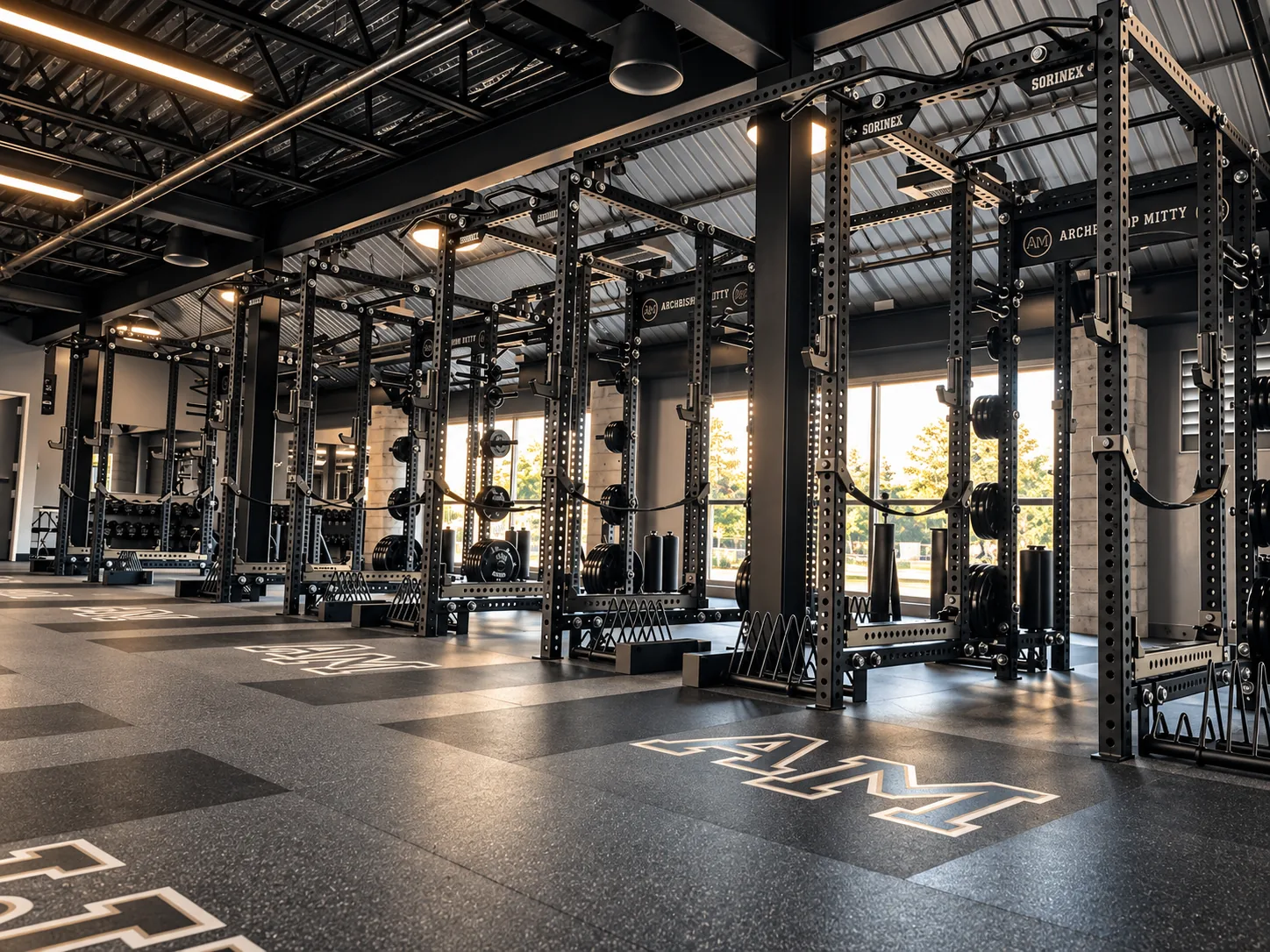
You can tell a lot about a training program before anyone starts coaching.
Sometimes before anyone even says hello.
Walk into the room.
Look at the floor.
Plates scattered around.
Bands hanging wherever somebody happened to leave them.
Hurdles kicked sideways.
Benches at odd angles.
A rack that looks like the last group left in a hurry.
And in about ten seconds, you already have an impression.
You might not know the programming.
You might not know the credentials of the staff.
You might not know whether the athletes are getting stronger, faster, or more resilient.
But you’ve already formed an opinion.
And if you’re a parent deciding where to trust your kid, that opinion matters.
The Room Is Talking
I’ve always been particular about organization.
Hurdles lined up.
Bands where they belong.
Bumpers stacked correctly.
Stations reset.
Aisles clear.
Call it obsessive if you want.
The point isn’t that every facility needs to look exactly like mine.
The point is that you notice.
Because the room is communicating something whether you intend it to or not.
Most rooms tell on themselves in the first ten seconds.
They tell you how much the staff notices.
They tell you whether there is a standard.
They tell you whether the last group was expected to clean up after themselves.
They tell you whether the details matter.
And more often than not, the physical environment gives you a clue about the operating culture behind it.
How You Do Anything
There’s an old saying:
How you do anything is how you do everything.
It gets overused.
But I think there’s some truth to it.
Years ago, when I was dabbling in real estate, I had a mentor who did something I didn’t fully understand until much later.
Whenever he interviewed someone, he would personally walk them back to their car afterward.
It seemed like hospitality.
He’d continue the conversation, walk you out, and when you got to your car, he’d even open the door for you.
I thought he was just being a good host.
Later, he told me what he was actually doing.
He wanted to see inside your car.
If he opened the door and saw water bottles everywhere, fast-food wrappers, papers on the floor, and a back seat that looked like it hadn’t been cleaned in six months, he took note.
It didn’t automatically mean you were a bad candidate.
But to him, it was a signal.
His thinking was simple:
The way you manage the things nobody expects to see can tell me something about the way you manage everything else.
That stuck with me.
And twenty-something years later, I catch myself doing essentially the same thing when I walk into a training facility.
I look at the floor.
Not because I’m judging whether the place is pretty.
I’m looking for signals.
Are the hurdles lined up?
Are the plates where they belong?
Are bands thrown over whatever rack happened to be closest?
Are the walkways clear?
Did the last group reset the room, or did they just leave?
Because a messy floor is rarely just about a messy floor.
It can be the same habit showing up somewhere else.
Sessions that start a few minutes late.
Equipment that never quite gets put back.
Athletes who finish a station and walk away.
Coaches who say they’ll reset the room later.
A warm-up that changes depending on who is running it.
Standards that exist verbally but disappear operationally.
None of those things feels catastrophic in isolation.
That’s what makes them dangerous.
One plate left on the floor.
One coach who doesn’t reset the station.
One group allowed to leave the room worse than they found it.
One more, “We’ll get it later.”
Eventually, later becomes the standard.
People Use What They Can See
Parents don’t know everything happening behind the scenes.
They usually don’t know how you periodize a program.
They don’t know how carefully you selected the exercise progression.
They don’t know whether your sprint volumes are appropriate.
They don’t know what your staff meetings sound like.
So they use what they can see.
That’s human nature.
They notice whether the room feels controlled or chaotic.
They notice whether the equipment looks cared for.
They notice whether athletes know where to go.
They notice whether coaches are prepared.
They notice whether somebody walks past a plate on the floor or picks it up.
And whether we like it or not, visible details influence how people feel about invisible ones.
If the room looks cared for, people assume there is thought behind the operation.
If the visible details are sloppy, they quietly begin wondering what else might be sloppy.
Programming?
Supervision?
Safety?
Communication?
Progress tracking?
Maybe that judgment isn’t always fair.
But it happens.
What Disorganization Actually Costs
This isn’t about making the room look nice for Instagram.
Organization affects how the facility works.
First impression
Parents scan a room faster than most owners realize.
You can give the best tour in the world.
The room already said something before you started talking.
Safety and flow
Equipment in the wrong place creates friction.
Plates on the floor become obstacles.
Hurdles left out interfere with movement.
Stations that aren’t reset create delays.
Athletes wait.
Coaches rearrange.
The session starts negotiating with the room instead of using it.
Training quality
Good coaching depends on flow.
If a coach has to stop every five minutes to find a band, move a bench, or rebuild a station, attention gets pulled away from the athlete.
You can’t coach speed well if the lane keeps changing.
You can’t coach loading well if the setup is constantly being rebuilt.
You can’t create rhythm if the room keeps fighting you.
Organization protects coaching bandwidth.
Culture
Athletes copy what they see.
If the staff leaves a mess, the athletes will too.
If coaches walk past plates on the floor, eventually athletes learn that those plates are somebody else’s responsibility.
But the opposite is true too.
If the room gets reset after every group, that becomes normal.
If coaches put things back without being asked, athletes begin doing the same.
Standards are contagious.
So is sloppiness.
Trust
This is the part that gets overlooked.
Trust is built through a lot of tiny observations.
People don’t always consciously register them.
They just develop a feeling.
This place is organized.
These coaches are paying attention.
My kid is being taken care of.
Or:
This feels loose.
Nobody seems responsible for the room.
I wonder what else I’m not seeing.
That matters.
Organization Isn’t Interior Design
A well-run room doesn’t need to be expensive.
It doesn’t need custom cabinetry.
It doesn’t need perfect lighting.
It doesn’t need to look like a commercial fitness showroom.
It needs a standard.
A place for things.
A reset between groups.
Clear walkways.
Equipment returned after use.
Coaches who put things back without being asked.
Athletes who understand that finishing the set includes resetting the station.
That’s not aesthetics.
That’s professionalism.
And athletes feel that too.
When the environment is orderly, the message is clear:
What happens here matters.
The Small Things Compound
One stray plate doesn’t ruin a program.
One crooked hurdle doesn’t destroy your culture.
One coach forgetting to reset a station is not a crisis.
The problem is repetition.
A year of “we’ll get it later” becomes something else.
A habit.
Then a culture.
Then an identity.
It’s the same math I talk about with athletes.
One missed workout usually doesn’t change your career.
One late night doesn’t either.
One skipped recovery session probably won’t show up tomorrow.
That’s the problem.
The same thing is true for your room.
The same thing is true for your staff.
The same thing is true for your culture.
The standard you tolerate today becomes the environment you’re operating in tomorrow.
Parents Don’t Need a Tour Script
If you run a sports performance facility, assume parents are evaluating you before you explain anything.
They’re looking at the environment.
They’re watching the coaches.
They’re watching how athletes move through the space.
They’re watching whether anyone cares enough to pick up the plate everyone else stepped over.
The best operators understand this.
They don’t create a clean room for visitors.
They build a system where the room stays ready because that is simply how the place operates.
That’s a much harder standard.
And a much more valuable one.
Make the Reset Part of the Work
You don’t need a 20-step SOP.
You need a few non-negotiables.
End of station.
Reset it.
End of group.
Reset it.
End of day.
Leave the room ready for the next one.
Hurdles squared.
Plates on trees.
Bands back where they belong.
Benches reset.
Aisles clear.
That’s it.
Not because the room needs to look perfect.
Because the environment teaches people what matters.
And if you say you’re building disciplined, accountable athletes, the room should reflect that.
The Room Is the Standard
Your programming matters.
Your coaching matters.
Your equipment matters.
But people experience the environment before they understand any of those things.
The room is the first part of your program they can actually see.
So here’s the question I’d ask:
Because it is telling me something.
And the first ten seconds are probably saying more than you think.