
Key takeaways
- Check whether athletes have a realistic opportunity to train before treating attendance as a motivation problem.
- Evaluate capacity by the quality of training you can deliver with the space, schedule, and staff available.
- Count walking, waiting, and setup as part of the time a session requires.
- Identify the specific constraint before buying equipment or adding another training location.
Start with a normal afternoon
Imagine a school with a good weight room and several teams finishing class at roughly the same time. Baseball needs to get to the field. Soccer has a limited window before practice. Basketball wants to lift before the gym is available. Everyone has a reasonable request.
There just aren't enough reasonable time slots.
The usual response is to keep adjusting the schedule. Move one team earlier. Ask another to stay later. Shorten a session. Eventually, somebody suggests that athletes need to be more committed.
Sometimes commitment is the issue. But an athlete who can't get a ride before school, or has to choose between lifting and getting to practice on time, has a different problem. A better motivational speech won't create another hour in the day.
Before asking why athletes aren't training consistently, follow the route you're asking them to take.
The session starts before the first set
Coaches tend to think of a lift as the time spent lifting. The schedule has to account for everything around it.
Athletes finish class, change, get across campus, wait for the previous group, and find their equipment. Afterward, they put everything away and head to practice. A 30-minute session can require a much larger opening in the afternoon.
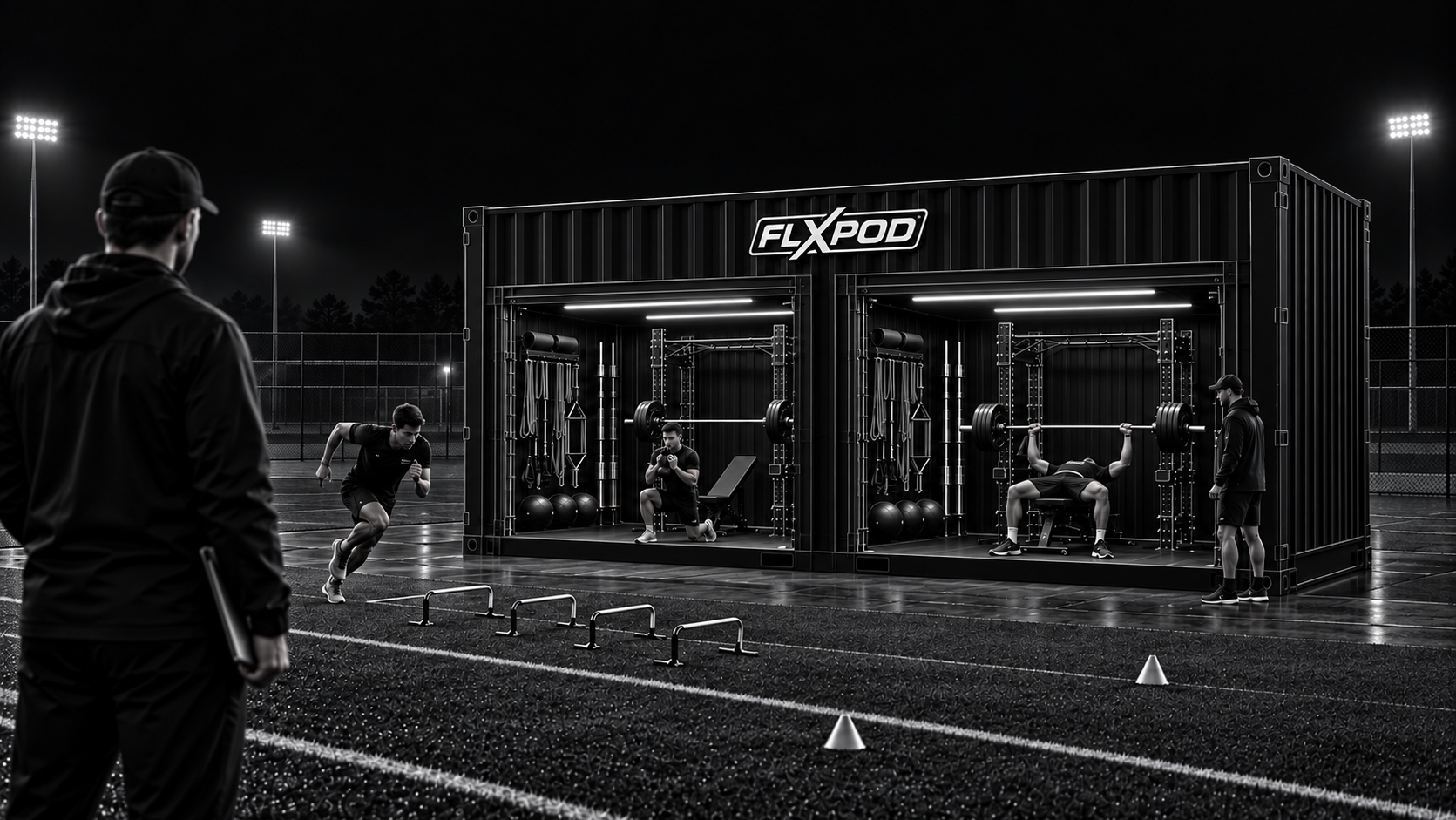
That was part of the problem behind the first FLXPOD. We knew the work we wanted our baseball athletes doing. Finding room for it around practice was harder. The weight room was somewhere else, other teams needed it, and every transition used time we couldn't get back.
Putting the training beside the field changed the question. We could look at where strength, preparation, or power work belonged in practice because we no longer had to move the entire team to another destination first.
That experience made proximity much more important to us. A facility's location affects how often athletes can realistically use it.
How many athletes can you train well?
Square footage tells you the size of a room. It doesn't tell you how a session runs.
Two spaces with the same footprint can work very differently. In one, groups move through familiar stations with equipment ready. In the other, athletes cross the room for plates, wait for a shared machine, and interrupt the coach to ask where they go next.
The useful question is how many athletes you can train well in the time you actually have.
“Well” matters. Packing more athletes into an hour isn't an improvement if the coach can't see their lifts or beginners are left to figure things out. Capacity includes enough space to move, appropriate rest, available equipment, and attention from someone who can coach the work.
Before planning an expansion, watch your busiest session. Notice where athletes wait and where the coach gets pulled away. An unused machine might be taking up valuable floor space. A storage problem might be slowing every transition. Or the room may simply have reached the limit of what it can handle.
Those are different problems, and they deserve different solutions.
Find the part that is holding everything up
Adding racks can help when athletes are waiting for racks. It won't help much when the room is empty because no coach is available to supervise it.
The same applies to adding another training location. More space can improve access, but someone still needs to run the sessions. If the existing coach is already stretched across several groups, another location could make supervision harder.
Look at four things together: space, staffing, scheduling, and the workout itself. Ask which one is preventing the next group of athletes from getting useful work.
Then make the smallest change that addresses that constraint. You might stagger arrivals, change an exercise that ties up shared equipment, or move suitable work into an adjacent area. You might need another coach. You might need more space.
The purchase should follow the diagnosis.
Look at the space around practice
The first FLXPOD began with a patch of ground beside our baseball field. The useful training environment turned out to be much larger than the pod itself.
The pod served as the equipment and coaching hub. The surrounding area gave athletes room to prepare, sprint, throw, and move between training and baseball work. We weren't trying to fit an entire team inside a container.
That's a useful way to evaluate your own campus. There may be space near a field that could support part of the training day, provided the surface, equipment, weather plan, and supervision make sense.
A central weight room can remain an important part of the program. Additional space near practice can take pressure off it and give teams another workable option.
But start with the session you need to run. A location is only useful if athletes and coaches can use it consistently.
Check access before you spend
For one normal week, record which teams train, which teams miss out, how much time is lost in transitions, and where sessions break down. Include younger athletes and teams that rarely get the preferred time slots.
You don't need an elaborate report. You need enough information to distinguish “we need a larger room” from “we need someone available at 3:30.”
Then ask what would give the athletes with the least access a dependable opportunity to train.
That answer is a much better starting point for your next investment than an equipment catalog.
General training information. Adapt activities to your athletes, equipment, and setting, with appropriate supervision.