
Every athlete I coach wants to get to the next level.
For you, that might mean making the team.
Earning a starting spot.
Playing varsity.
Competing in college.
Becoming an All-American.
Playing professionally.
The destination changes. What it takes to get there really doesn’t.
I’ve spent more than 20 years as a strength and conditioning coach working with thousands of athletes—from young athletes just beginning to take their development seriously to professionals competing at the highest levels.
I’ve also lived it myself.
I wasn’t recruited out of high school. I walked on at a Division II school and eventually earned the opportunity to play professional baseball.
I’ve been overlooked. I’ve been told no. I’ve had things not go according to plan.
And after all those years playing, coaching, watching, and learning, I’ve become less interested in predicting how far a young athlete will go.
I’m much more interested in watching what they do every day.
Because talent matters.
Genetics matter.
Coaching matters.
Opportunity matters.
Luck probably matters a little, too.
But there are certain things you control.
And if you’re serious about finding out how good you can become, I want you to understand three of them.
01 — THE WORK IS NON-NEGOTIABLE.
Everybody wants the result.
Far fewer people want the routine required to produce it.
Your strength work matters.
Your speed work matters.
Your skill development matters.
Your mobility and prehab matter.
Your recovery matters.
Your nutrition matters.
Your academics matter.
Those are the big rocks.
Do them first.
Before the phone. Before the games. Before scrolling. Before all the little things that somehow consume the time you said you didn’t have.
There’s a phrase I’ve always loved:
That might sound backward.
Discipline feels restrictive. Freedom sounds like doing whatever you want.
But discipline is what eventually gives you options.
The freedom to compete at a higher level.
The freedom to choose between opportunities.
The freedom to stay healthy and available.
The freedom to perform with confidence because you know you’ve prepared.
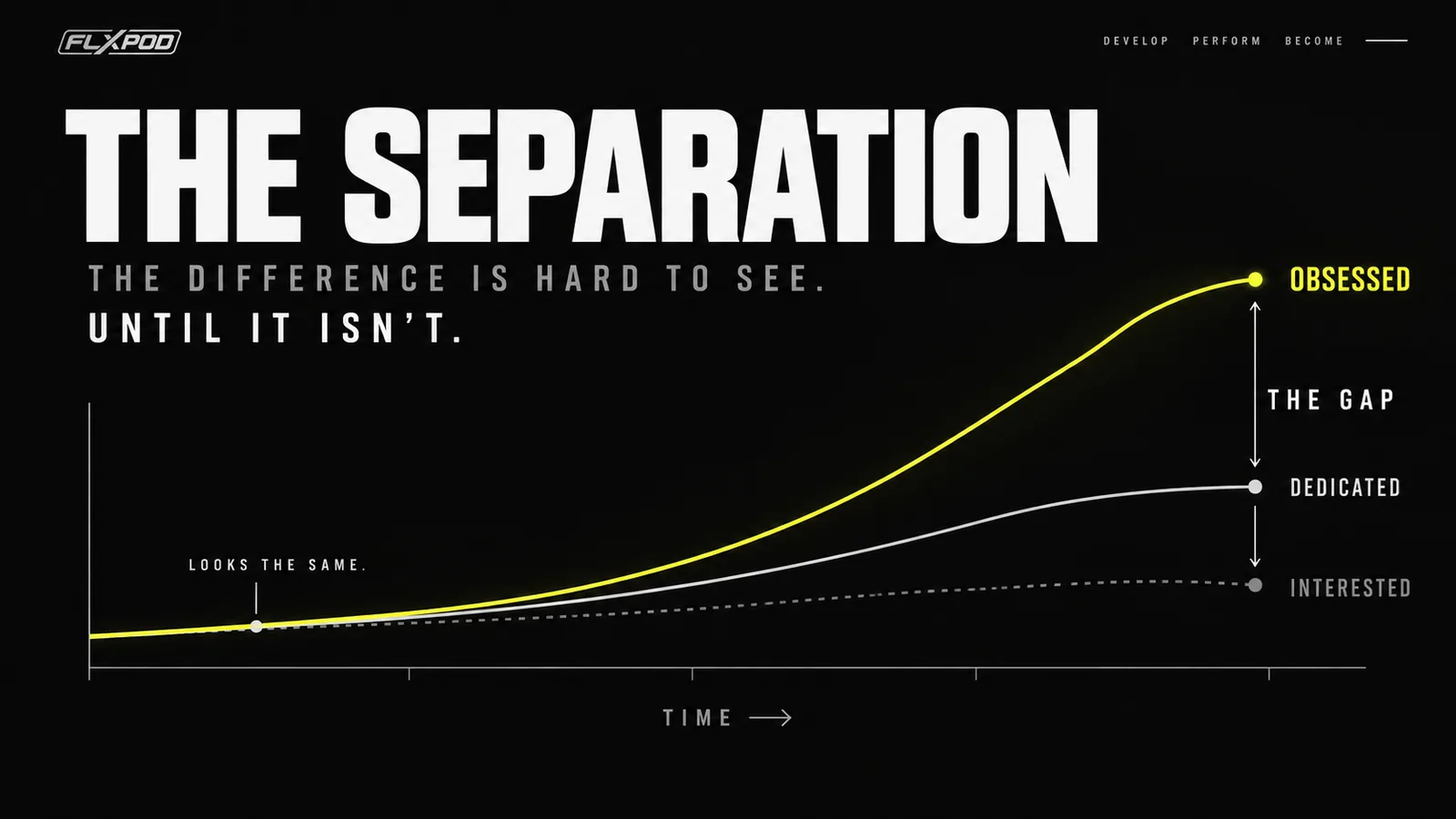
Over the years, I’ve started thinking about athletes in three categories:
Interested athletes like the idea of being good.
They enjoy competing. They like the gear, the highlights, the recognition, and everything that comes with being an athlete.
But when the work becomes inconvenient, it becomes negotiable.
Then there are the dedicated.
Dedicated athletes show up. They work hard. They’re dependable. They can become very good players and make a significant impact on their teams.
But there’s another level.
Obsessed athletes obsess over the details.
I don’t mean unhealthy obsession. I don’t mean training all day or allowing your sport to become your entire identity.
I mean caring deeply about the little things most people overlook.
Five extra minutes of mobility.
Getting enough sleep.
Taking the warm-up seriously.
Eating something that actually helps you recover.
Doing your prehab when nothing hurts.
Getting the work in when nobody is checking.
Taking care of your academics.
Watching film with intention.
Asking a better question.
Taking one more quality rep.
None of those things seems particularly important today.
That’s the trick.
One better decision doesn’t change much.
One missed session probably doesn’t either.
One late night. One skipped recovery session. One wasted afternoon. One time choosing the easy thing instead of the thing you know you need to do.
You probably won’t notice the difference tomorrow.
But stack those choices for three or four years and something happens.
The trajectories separate.
The athlete who consistently handled the details begins pulling away from the athlete who handled them sometimes.
At first, they looked almost identical.
Eventually, they don’t.
The difference is hard to see. Until it isn’t.
That’s the separation.
Same dream.
Same 24 hours in a day.
Very different trajectory.
02 — DON’T WAIT TO BE PICKED.
This one is personal for me.
I wasn’t recruited out of high school.
There wasn’t a line of college coaches waiting to give me an opportunity.
So I walked on.
Eventually, I earned the opportunity to play professionally.
Looking back, being overlooked was one of the greatest gifts sports ever gave me.
Because I learned early that nobody was coming to pick me.
And I want you to understand that too.
You’re growing up in an era where it’s almost impossible not to compare your journey to everyone else’s.
Rankings.
Showcases.
Social media.
Commitment posts.
Follower counts.
Statistics.
Who got invited.
Who got the offer.
Who made the team.
Who’s starting.
Who’s getting attention.
Some of those things matter.
But none of them changes today’s assignment.
You don’t need anyone’s permission to do that.
You can’t control who’s watching.
You can control what they see when they finally are.
You can’t control your ranking.
You can control whether you’re stronger, faster, healthier, and more skilled six months from now.
You can’t always control playing time.
You can control what you do with the opportunities you’re given.
And you definitely can’t control someone else’s timeline.
So stop waiting for somebody else to validate the athlete you believe you can become.
Become impossible to ignore.
Sports will give you plenty of opportunities to feel overlooked.
Good.
Learn what to do with that feeling.
Because someday your competitive career will end.
The ability to create your own opportunities won’t.
03 — FIND A WAY.
Eventually, something is going to go wrong.
Probably a lot of things.
You’ll get overlooked.
You’ll lose.
You’ll have a terrible performance.
Someone younger may pass you.
You’ll plateau.
You might get hurt.
You may lose your confidence.
A coach may not see in you what you see in yourself.
You may work harder than you’ve ever worked and still not get the result you thought you deserved.
That’s sports.
That’s life, too.
I’ve had enough things not go according to plan in my own life to stop believing the goal is avoiding adversity.
The goal is becoming someone who knows what to do when it arrives.
That’s why one of my favorite questions for an athlete facing a problem is incredibly simple:
Not:
Whose fault is it?
Why is this happening to me?
Is this fair?
Instead:
What can I do next?
When things don’t go according to plan, you have a choice. You can spend your energy wishing the circumstances were different—or start looking for the next move. Jocko Willink explains this better than I can.
Find a way.
Maybe you need to work harder.
Maybe you need to work smarter.
Maybe you need to ask for help.
Maybe you need to change your approach.
Maybe you need to be patient.
Maybe you need to admit that what you’re doing isn’t working.
Maybe you need to knock on another door.
But you don’t surrender your agency.
Sometimes finding a way means going through the wall.
Sometimes it means going around it.
Sometimes it means climbing over it.
And sometimes it means realizing you’ve been pushing on the wrong wall altogether.
Adjust.
Learn.
Keep moving.
Because the obstacle in front of you isn’t always telling you to stop.
Sometimes it’s showing you what you still need to become.
The Calendar Is Moving Either Way
There’s something I want you to understand about all three of these ideas.
Time doesn’t care.
The calendar keeps moving whether you’re doing the work or not.
A year from now will arrive.
So will three years from now.
So will four.
And when you look at two athletes today, the difference between them might be almost impossible to see.
One sleeps a little better.
One takes the warm-up more seriously.
One gets the extra work in.
One takes care of school.
One asks for help.
One responds differently when things go wrong.
One keeps finding a way.
Small things.
Until you give them time.
Then they aren’t small anymore.
The calendar moves everyone forward. Your habits determine the trajectory.
You don’t suddenly wake up one morning and become the athlete you’ve been talking about becoming.
You build that athlete.
Rep by rep.
Choice by choice.
Day by day.
And eventually, the difference becomes hard to miss.
Three Questions Before You Go to Bed
If you’re serious about getting to the next level, don’t make this complicated.
Tonight, ask yourself three questions.
Did I take care of my big rocks today, even when nobody was making me?
Did my choices today move me closer to the athlete—and person—I say I want to become?
When something didn’t go according to plan, did I make an excuse or find a response?
That’s it.
You don’t need to have your entire athletic career figured out right now.
You don’t need to know exactly where you’ll play three years from now.
You don’t need to know whether you’ll get the scholarship, make the team, earn the starting spot, or eventually get paid to play your sport.
None of us know.
But you can decide what kind of athlete you’re going to be today.
And tomorrow morning, you get to make that decision again.
There will always be somebody bigger.
Somebody faster.
Somebody stronger.
Somebody ranked higher.
Somebody getting more attention.
Somebody who seems further ahead.
Let them have their journey.
You have yours.
Do the work.
Don’t wait to be picked.
Find a way.
Then wake up tomorrow and do it again.