
Key takeaways
- Many athletic programs face a capacity problem before they face a motivation or culture problem.
- Measure a training space by athletes trained well per hour, not square footage alone.
- Distributed training environments can put development closer to where athletes practice.
- Identify whether space, staffing, scheduling, or programming is the true bottleneck.
There are beautiful playing surfaces. New scoreboards. Batting cages. Film rooms. Locker rooms. Lighting. Uniforms. Technology everywhere.
Then ask where 150 athletes are supposed to get stronger.
Usually, everybody points to the same room.
That’s the problem.
For years, we’ve treated the weight room as a room instead of what it really is: infrastructure. And once you begin looking at athletic performance through that lens, you start seeing a problem that exists at schools and clubs all over the country.
There simply isn’t enough training capacity.
The Capacity Gap
Imagine a school with 500 student-athletes.
There may be one weight room. Maybe there are eight racks. Maybe twelve. There are several teams trying to use it before school, after school and during athletic periods.
Football gets priority. Then everyone else starts negotiating.
Baseball wants 3:00.
Girls soccer practices at 3:30.
Basketball needs the room before practice.
The wrestling team is already in there.
Middle-school athletes barely get access at all.
This isn’t necessarily a coaching problem. It’s math.
The facility may be perfectly good. There just isn’t enough of it.
That difference matters because the normal reaction is to blame the program.
“We need better participation.”
“We need athletes to take strength training more seriously.”
“We need coaches to buy in.”
Maybe.
But before we diagnose a culture problem, we should probably make sure athletes actually have a realistic opportunity to train.
Access comes before compliance.
A Weight Room Only Has So Much Throughput
Coaches understand this intuitively because they live it every afternoon.
If six racks are available and 40 athletes arrive at once, something has to give. Athletes wait. Exercises get skipped. Rest periods get shortened. Technique gets less coaching. Sessions take too long.
Eventually sport coaches decide lifting is interfering with practice.
The program gets cut from four days to three, three to two, or two to “when we have time.”
Then we wonder why athletes aren't developing.
The issue isn’t necessarily the program.
The system simply cannot process the number of athletes being asked to move through it.
That is a capacity problem.
Stop Measuring Weight Rooms in Square Feet
Square footage is useful to architects.
It isn’t necessarily the best measurement for coaches.
A better question is: How many athletes can we train well in an hour?
That changes the conversation.
A 5,000-square-foot room filled with single-purpose equipment may have less useful training capacity than a smaller space designed around athlete flow, open movement space and versatile equipment.
The goal shouldn’t be to own the most equipment.
The goal should be to create the greatest amount of useful training.
That sounds obvious until you walk through athletic facilities.
You’ll see equipment nobody uses occupying space athletes desperately need.
You’ll see a $7,000 machine that can train one athlete at a time sitting ten feet from an open area where six athletes could be jumping, doing medicine-ball work or completing movement preparation.
Equipment looks impressive.
Capacity is useful.
There is a difference.
Boyle makes essentially this operational point in his facility work: poor logistics can stop good programming from ever becoming a good training session, and floor flow directly affects how many athletes can be served.
Athletic Development Should Be Closer to Practice
There is another issue we rarely discuss: geography.
Where is the weight room in relation to where athletes practice?
That sounds trivial until you operate a program.
A baseball player finishes school, walks to the weight room, changes, trains, walks back across campus and starts baseball practice.
Or baseball practice comes first and the athlete is supposed to walk across campus afterward and lift.
Now do that with soccer.
Lacrosse.
Softball.
Track.
Volleyball.
The further athletic development is separated from sport practice, the harder it becomes to integrate the two.
That is why I believe the future of athletic development will become increasingly distributed.
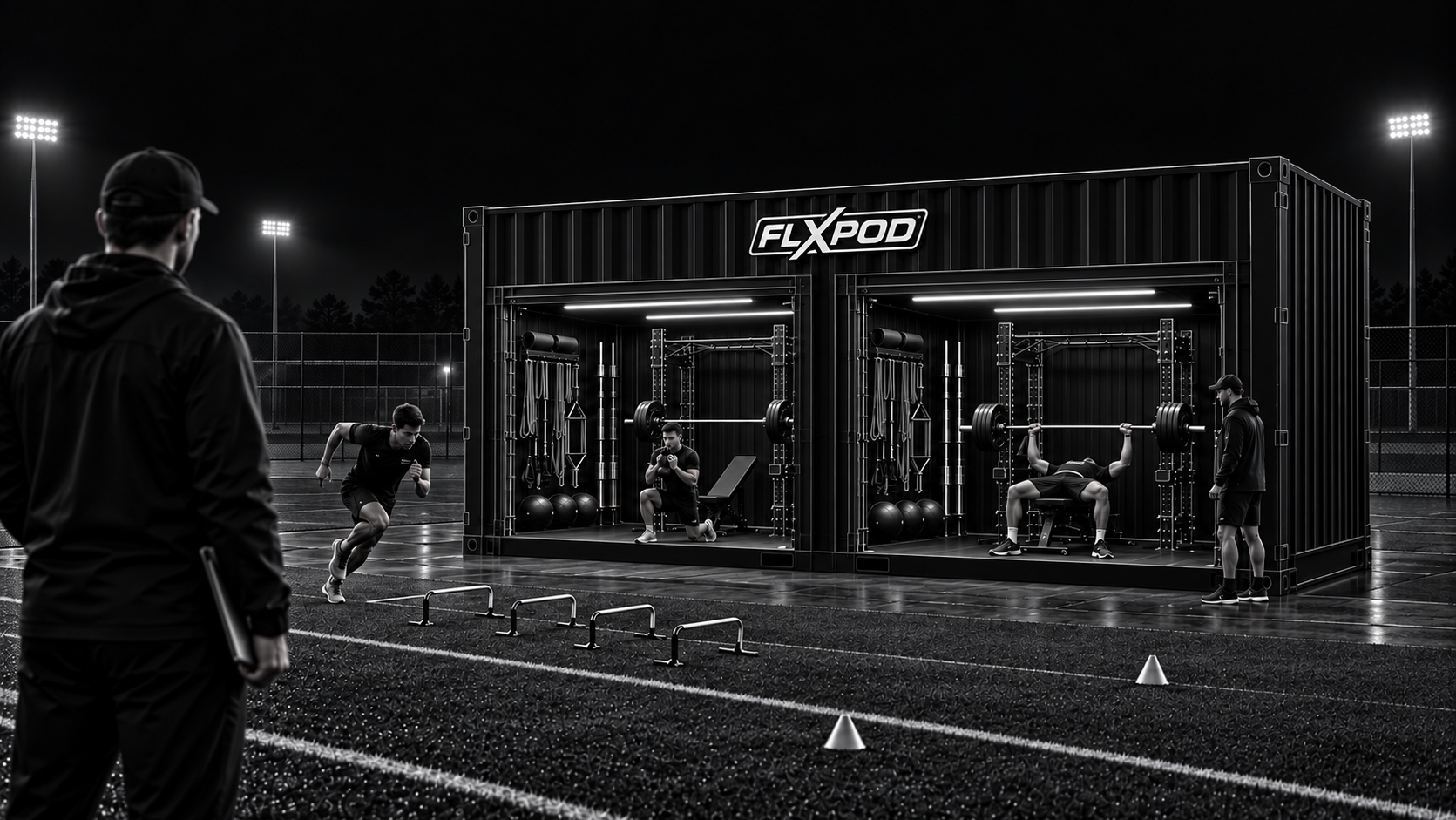
Instead of asking every athlete to come to one centralized room, we can begin putting performance capacity closer to athletes.
Think satellite training environments.
A baseball and softball performance space near the diamonds.
A training space near soccer and lacrosse fields.
A smaller developmental facility serving middle-school athletes.
The traditional weight room doesn’t disappear.
It becomes the hub.
Additional training capacity becomes the spokes.
This Is Not a Shipping-Container Argument
FLXPOD happens to use a deployable structure.
But the larger idea has nothing to do with containers.
The idea is distributed performance infrastructure.
If your school can build a second 10,000-square-foot performance center, great. Build it.
Most programs cannot.
Construction is expensive. Space is limited. Budgets compete with classrooms, fields, roofs, buses and every other capital project a school needs.
So the question becomes much more practical:
How can we create another high-quality place for athletes to train without waiting years for another building?
That is the question worth solving.
Build Capacity Before Adding Complexity
The performance industry loves complexity.
Force plates.
Velocity trackers.
AI.
GPS.
Readiness scores.
All of those technologies can have value.
But technology does not solve an access problem.
Before asking how precisely we can measure an athlete, we should ask whether that athlete gets two or three quality exposures to speed, strength and power every week.
Before buying another dashboard, make sure the athlete can actually train.
This is basic infrastructure thinking.
Roads before autonomous vehicles.
Runways before airplanes.
Training capacity before training technology.
The Athletic Director’s Question
If I were an athletic director evaluating my performance system, I would ask one simple question:
Can every athlete in our program receive consistent access to quality athletic development?
Not football.
Not varsity athletes.
Every athlete.
If the answer is no, you have found the problem.
The next question isn’t immediately, “What equipment should we buy?”
It is:
Where is capacity breaking down?
Maybe it’s space.
Maybe staffing.
Maybe scheduling.
Maybe programming.
Maybe all four.
But once you identify the bottleneck, you can begin engineering a solution.
Because the goal isn’t a better weight room.
The goal is more athletes getting better.
That is athletic performance infrastructure.